

Barbed wire is a type of fencing that features sharp metal points, or barbs, spaced evenly along the wire. It’s commonly used for security, managing livestock, and marking boundaries, as it provides both a physical and psychological deterrent.
First patented in the late 1800s, barbed wire quickly revolutionized farming and land management in the American West. Often referred to as the “Devil’s Rope,” it enabled ranchers to fence off large tracts of land swiftly and affordably, fundamentally changing how they managed livestock and safeguarded their properties.
Today, barbed wire continues to be one of the most effective and economical fencing options available globally. It finds applications in agriculture, industrial security, transportation systems, and military uses.
Raw Materials and Chemical Composition
The Base Metal
Barbed wire is mainly manufactured from carbon steel wire. The steel used can vary depending on the intended application and required strength.
High-Tensile Steel Wire
High-tensile wire contains higher carbon content, giving it greater strength and durability. It can maintain tighter fence tension over long distances and is more resistant to stretching or sagging.
Advantages:
Higher strength
Longer lifespan
Reduced maintenance
Suitable for large farms and security fencing
Soft Steel Wire
Soft or low-carbon steel wire is easier to bend and install. It is commonly used for light agricultural fencing and temporary enclosures.
Advantages:
Easier handling
Lower installation force required
More flexible during fencing work
Corrosion Resistance
Because barbed wire is usually installed outdoors, corrosion resistance is essential. Manufacturers protect the steel through galvanization.
Hot-Dip Galvanized Barbed Wire
In this process, the steel wire is submerged in molten zinc, forming a thick protective coating.
Features:
Excellent rust resistance
Longer service life
Ideal for humid or coastal environments
Electro-Galvanized Barbed Wire
Electro-galvanizing uses electrical current to apply a thinner zinc coating.
Features:
Smoother appearance
Lower cost
Suitable for dry environments and light-duty applications
Hot-dip galvanized wire generally provides much better durability than electro-galvanized wire.
Grade Variations
Barbed wire is available in different quality grades.
Commercial-Grade Wire
Lower zinc coating
Standard tensile strength
Suitable for basic farm fencing
Industrial-Grade Wire
Higher tensile strength
Heavier zinc coating
Better corrosion resistance
Used in security and infrastructure projects
Some premium products also use PVC coating for additional weather protection and improved appearance.
The Manufacturing Process
Wire Drawing
The manufacturing process begins with steel wire rods. These rods are pulled through a series of dies to reduce their diameter and achieve the required wire gauge.
This process improves:
Dimensional accuracy
Surface smoothness
Mechanical strength
Common barbed wire gauges include 12.5 gauge and 14 gauge.
Annealing
After drawing, the wire may undergo annealing, a heat-treatment process that improves flexibility while maintaining strength.
Annealing helps:
Prevent wire cracking
Improve twisting performance
Make installation easier
The exact annealing temperature depends on the wire grade and application.
The Barbing Mechanism
The sharp barbs are created by cutting short pieces of wire and twisting them around one or two main line wires.
The machine:
Feeds the main strands continuously
Cuts barb wire sections
Wraps and locks the barbs in position
Maintains consistent spacing
The result is a durable fencing wire with evenly distributed sharp points.
Twisting Patterns
Single-Strand Twist
A single line wire holds the barbs in place.
Advantages:
Lower cost
Lightweight
Easier installation
Double-Strand or Reverse Twist
Two line wires are twisted together with the barbs locked between them.
Advantages:
Higher strength
Better stability
More secure fencing
Reverse-twist barbed wire is commonly used for livestock and security applications.
Key Specifications and Types
Wire Gauges
Wire gauge determines the thickness and strength of the wire.
Common Agricultural Sizes
12.5 gauge
13 gauge
14 gauge
Heavy-Duty Security Sizes
11 gauge
12 gauge
Thicker wire offers greater durability and resistance to cutting or breaking.
Barb Geometry
Barbed wire can have different barb designs.
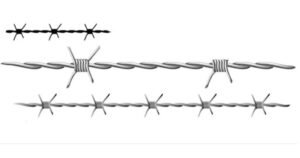
Two-Point Barbs
Fewer sharp ends
More economical
Common in agricultural fencing
Four-Point Barbs
Increased deterrence
Better security performance
Widely used in industrial and military fencing
Barb spacing typically ranges from 3 to 6 inches depending on application requirements.
Tensile Strength
Tensile strength measures how much force the wire can withstand before breaking.
High tensile strength is important because it
Prevents fence sagging
Maintains tension over long distances
Improves livestock containment
Enhances perimeter security
Stronger wire also reduces long-term maintenance costs.
Applications Across Industries
Agriculture
Barbed wire is heavily used on farms and ranches for
Cattle fencing
Sheep containment
Farm boundary marking
Crop protection
Its affordability makes it ideal for fencing large rural areas.
Security and Defense
Barbed wire is widely used in:
Military facilities
Prison fencing
Industrial compounds
Warehouses
Restricted areas
In high-security installations, it is often combined with razor wire, electric fencing, or surveillance
Infrastructure
Transportation and public infrastructure sectors also use barbed wire for:
Railway boundaries
Highway protection
Construction site security
Airport perimeter fencing
The wire helps prevent unauthorized access and improves safety.
Installation and Maintenance Best Practices
Proper Tensioning Techniques
Correct tension is essential for fence performance.
Over-tightening may damage the wire, while loose wire can sag and reduce effectiveness.
Fence installers commonly use:
Tensioning tools
Fence strainers
Durable fence posts
Proper post spacing also improves fence stability.
Safety Considerations
Barbed wire can cause serious injury if handled improperly.
Recommended safety equipment includes:
Heavy-duty gloves
Eye protection
Long sleeves
Proper wire cutters
Careful handling during installation is essential.
Inspection and Maintenance
Routine inspections help extend fence life.
Check regularly for:
Rust or corrosion
Broken strands
Loose staples
Sagging sections
Damaged sections should be repaired immediately to maintain fence effectiveness.
Conclusion
Barbed wire remains one of the most dependable and cost-effective fencing options available today. Primarily made from galvanized steel wire, it offers a combination of strength, durability, and straightforward manufacturing processes, making it effective for security and livestock management. From farms and highways to industrial sites and military installations, barbed wire is a crucial component of modern infrastructure. As security technology advances, traditional fencing systems are increasingly integrated with electronic monitoring, sensors, and surveillance systems, resulting in smarter and more efficient perimeter protection solutions.